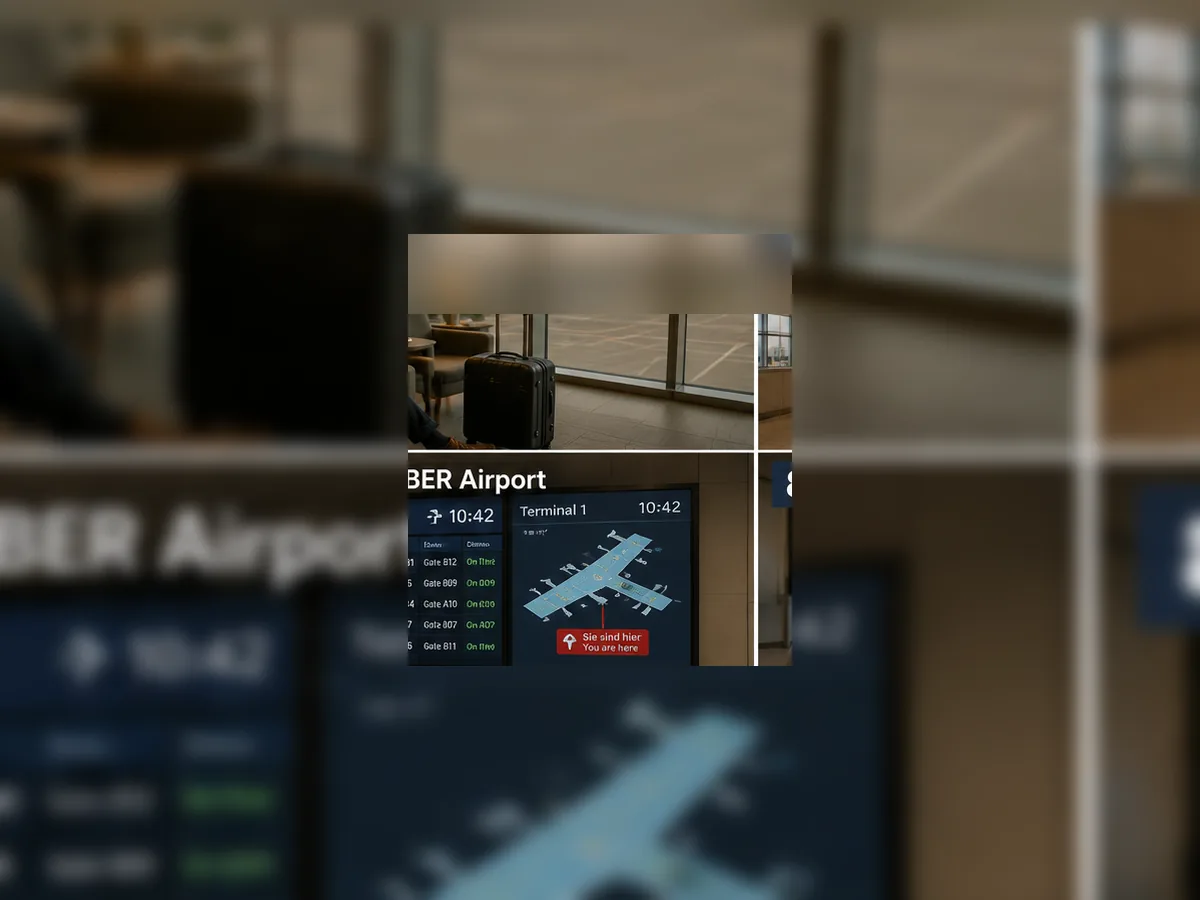
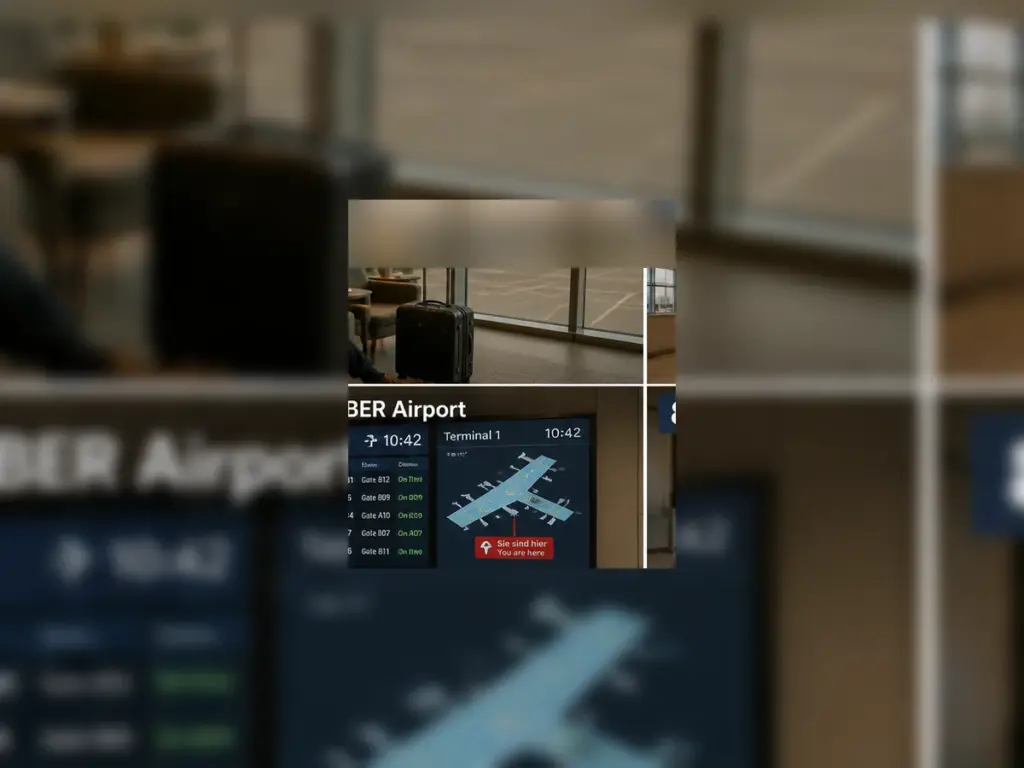
The BER Airport layout is built around two passenger terminals, a railway station under Terminal 1, connected public areas, arrivals and departures zones, security controls, baggage claim, parking, taxi and transfer routes. Understanding this layout before travel can save time and reduce stress at Berlin Brandenburg Airport.
This BER Airport layout guide explains how Terminal 1, Terminal 2, the train station, arrivals, departures and ground transport areas fit together. It is written for passengers who want practical orientation before a flight, pickup, arrival or private airport transfer.
Important: airport layouts, signs, counters, gates and service points can change. Use this guide for orientation, but follow current airport signs and flight information on the travel day.
BER Airport layout at a glance
- Airport: Berlin Brandenburg Airport Willy Brandt
- IATA code: BER
- Main terminals: Terminal 1 and Terminal 2
- Station position: below Terminal 1 on level U2
- Terminal 2 route: from the Terminal 1 area via arrivals level E0 and signs to T2
- Main passenger flows: check-in, security, gates, arrivals, baggage claim, pickup, parking and public transport
How the BER Airport layout works
The easiest way to understand BER is to treat Terminal 1 as the central reference point. Terminal 1 is connected to the airport train station below it. Terminal 2 is beside Terminal 1 and reached by a short signposted walking route.
Departing passengers move from the public area to check-in, baggage drop, security and then the gate area. Arriving passengers move from the aircraft route through passport control if required, baggage claim and then into the public arrivals area. Ground transport is planned around the terminal used and the passenger’s final destination.
For a broader visual orientation, see BER Airport Map Guide. For the full airport overview, see BER Airport Guide 2026.
Terminal 1 layout
Terminal 1 is the main terminal and the central layout point for many passengers. The train station is below Terminal 1, and the terminal connects passengers to check-in, arrivals, departures, security, gates, parking and ground transport areas.
Terminal 1 is important even for some passengers who fly from Terminal 2, because rail passengers arrive first under Terminal 1. From there, they follow airport signs to Terminal 2. This is why Terminal 1 should be understood as the main orientation anchor of the airport.
For detailed terminal guidance, see BER Airport Terminal 1 Guide.
Terminal 2 layout
Terminal 2 is located next to Terminal 1 and is connected by a walking route. It has its own passenger process, including check-in and security, but it remains part of the same airport layout. Passengers should not treat Terminal 2 as a separate airport building far away from Terminal 1.
Terminal 2 is especially important for passengers arriving by train. The train station is under Terminal 1, so Terminal 2 passengers need to include the walking route in their plan. This is simple with light luggage but can take longer with children, large suitcases or reduced mobility.
For detailed terminal guidance, see BER Airport Terminal 2 Guide.
Train station and airport layout
The airport station “Flughafen BER” is located directly under Terminal 1. It is one of the most important layout points because many passengers arrive or leave by train. From the station, Terminal 1 is directly above, while Terminal 2 is reached by following the signposted route through the terminal area.
The station position affects departure timing. If you are flying from Terminal 1, the route from platform to check-in can be direct. If you are flying from Terminal 2, add walking time. If you arrive with luggage after a long trip, also consider how far the final destination is from the train line.
For more rail detail, see BER Airport Train Station Guide.
Departures layout
The departures layout starts with terminal choice. Passengers need to know whether the flight uses Terminal 1 or Terminal 2. From there, the route normally continues to check-in or baggage drop, then security control, then the gate area.
If you are already checked in and travelling with hand luggage only, the process may be shorter. If you have checked baggage, special baggage or document checks, allow more time. Non-Schengen departures may also involve passport control after security.
For departure planning, see BER Airport Departures Guide, BER Airport Check-in Guide and BER Airport Security Control.
Arrivals layout
The arrivals layout depends on the route, terminal and baggage. After landing, passengers follow signs through the arrivals route. Non-Schengen passengers may pass passport control before baggage claim. Passengers with checked luggage collect baggage before entering the public arrivals area.
Once in the public area, passengers continue toward pickup, taxi, parking, public transport, hotel shuttle or a private transfer meeting point. The correct route depends on terminal and the type of onward travel.
For arrival planning, see BER Airport Arrivals Guide and BER Airport Baggage Claim Guide.
Passport control in the layout
Passport control is not relevant to every passenger, but it is an important part of the layout for non-Schengen travel. On arrivals, it can happen before baggage claim and before the public area. On departures, it can happen after security and before the gate area.
This means pickup and transfer timing should not be based only on landing time or driving time. If passport control is part of the journey, add a realistic buffer before arranging a meeting point or vehicle pickup.
For more detail, see Passport Control at BER Airport.
Ground transport layout
Ground transport at BER includes train, taxi, parking, pickup, private transfer and road access. The best option depends on terminal, luggage, group size, destination and time of day. The train station is convenient for some passengers, while private transfer can be easier for door-to-door travel.
If you are being picked up, terminal clarity is essential. A pickup planned for the wrong terminal or wrong level can create unnecessary walking and delays. Always share flight number, terminal and arrival details with the driver.
For airport pickup, see Transfer from BER Airport. For airport drop-off, see Transfer to BER Airport. For the main airport service overview, see Airport Transfers from BER Airport.
Walking routes inside BER
Walking routes are part of the real airport layout. A route can look short on paper but take longer with luggage, children, mobility needs or crowds. Terminal 2 passengers should especially include walking time from the Terminal 1 station area.
Passengers should also allow time after security to reach the gate. Gate distance can vary, and boarding may begin before the scheduled departure time. Waiting near the wrong area can create stress if the gate is far away.
How the layout affects private transfers
For private transfers, the layout affects both pickup and drop-off. Departing passengers need the correct terminal and enough time for check-in, baggage drop and security. Arriving passengers need time for passport control, baggage claim and walking to the meeting point.
A good transfer plan includes flight number, passenger name, terminal, luggage amount and contact details. This helps the driver prepare for arrival changes, delays and the correct pickup location.
Layout tips for families
- Check terminal before leaving home or hotel.
- Allow extra walking time for Terminal 2.
- Keep passports, boarding passes and children’s documents accessible.
- Use lifts when travelling with strollers or heavy bags.
- Choose a clear meeting point if the family separates.
- Do not plan tight timing around baggage claim or passport control.
Layout tips for business travellers
Business travellers should plan the airport layout around predictability. If arriving for a meeting, allow time from aircraft door to public arrivals, not only landing time. If departing after a meeting, plan for road traffic, check-in, security and walking to the gate.
When time is tight, door-to-door transfer can reduce uncertainty compared with public transport plus walking routes. This is especially relevant for early departures, late arrivals and destinations outside the most direct rail corridors.
Common BER layout mistakes
- Assuming Terminal 2 has the train station directly below it.
- Forgetting that Terminal 2 is reached from the Terminal 1 station area.
- Planning pickup without confirming terminal and arrival route.
- Ignoring baggage claim time after arrival.
- Ignoring passport control for non-Schengen routes.
- Waiting too long before walking to the gate after security.
- Planning airport timing only around driving time.
BER Airport layout checklist
- Confirm terminal: T1 or T2.
- Check how you will arrive: train, car, taxi or private transfer.
- Add walking time from station to terminal.
- Include check-in, baggage drop, security and gate walking for departures.
- Include passport control and baggage claim for arrivals if relevant.
- Confirm pickup or drop-off location before travel.
- Use online booking if you prefer a planned door-to-door transfer.
FAQ
What is the basic BER Airport layout?
BER has Terminal 1, Terminal 2, a train station below Terminal 1, arrivals and departures zones, security, baggage claim and ground transport areas.
Is Terminal 2 far from Terminal 1?
No. Terminal 2 is next to Terminal 1 and can be reached on foot, but passengers should still include walking time, especially with luggage.
Where is the train station in the BER layout?
The airport train station is directly under Terminal 1 on level U2.
Why does the layout matter for arrivals?
The layout affects how long it takes to pass passport control if needed, collect baggage, reach the public area and meet a driver or continue by train.
Why does the layout matter for departures?
The layout affects check-in, baggage drop, security, passport control for some routes and walking time to the gate.
Plan your BER Airport route
Before travelling, confirm your terminal, arrival or departure process, walking route and onward transport. If you want a planned door-to-door ride instead of navigating the airport layout with luggage, use online booking to arrange the route, vehicle and pickup details in advance.