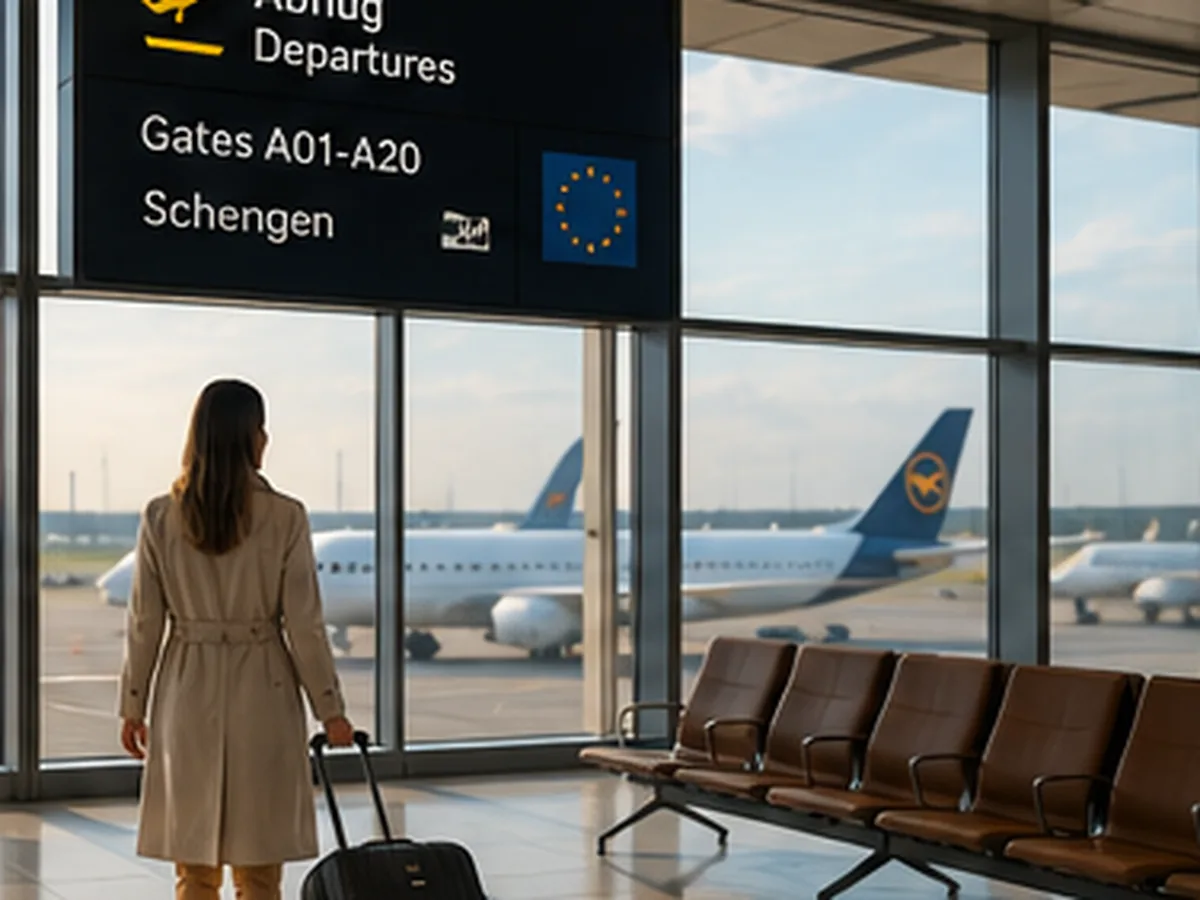
Schengen flights at BER Airport are usually simpler than flights outside the Schengen area because passengers normally do not pass routine border control between Schengen countries. Still, a Schengen flight from Berlin Brandenburg Airport is not “no process”. You still need the correct terminal, check-in, baggage drop, security control, boarding pass, ID, gate timing and transport plan.
This guide explains how Schengen flights work at BER Airport. It covers Terminal 1, Terminal 2, security control, gate access, ID documents, baggage, checked luggage, connecting flights, transit, layovers, delays, cancellations, families, senior travellers, business travellers, public transport, taxi and private transfer.
Important: Schengen status, airline rules, temporary border measures, document checks, security waiting times, gate changes and terminal assignments can change. Always check your airline, flight status and travel documents before departure.
Schengen flights at BER Airport at a glance
- Main terminals: Terminal 1 and Terminal 2.
- Main process: check-in or bag drop, security control and boarding.
- Border control: routine passport control is generally not part of ordinary Schengen-to-Schengen travel, but documents can still be checked.
- Security controls: controls in Terminals 1 and 2 generally give access to all departure gates.
- Train station: under Terminal 1 on Level U2.
- Key risk: arriving late, baggage drop, security waiting time or wrong terminal can still make a Schengen flight stressful.
What is a Schengen flight?
A Schengen flight is a flight between airports inside the Schengen area. For passengers, the main difference is that Schengen flights generally avoid routine passport control at internal Schengen borders. This does not remove the need for a valid passport or national ID where required by airline, country or passenger status.
Schengen travel is often faster than routes that require border control, but BER passengers still need airport time for check-in, baggage, security, gate walking, boarding and possible airline document checks.
For general preparation, see BER Airport Travel Checklist and First Time at BER Airport.
Schengen flights from Terminal 1
Terminal 1 is the main BER terminal with check-in counters, security, gate access, food areas, shops, lounges, baggage claim, airport station access, taxi ranks and airport hotel access.
If your Schengen flight departs from Terminal 1, arrive early enough to find the airline check-in area, drop baggage if needed, pass security and walk to the gate without rushing.
For orientation, see BER Airport Terminal 1 Guide, BER Airport Layout Guide and BER Airport Map Guide.
Schengen flights from Terminal 2
Terminal 2 is close to Terminal 1, but passengers should still allow walking time. If arriving by train, the airport station is under Terminal 1 on Level U2, so Terminal 2 passengers need extra time from the station route.
Check the terminal before leaving for BER. Going to Terminal 1 when your Schengen flight departs from Terminal 2 can cost valuable time.
For Terminal 2 planning, see BER Airport Terminal 2 Guide and BER Terminal 1 vs Terminal 2.
Do Schengen flights need passport control at BER?
Ordinary Schengen-to-Schengen flights usually do not require routine passport control like routes outside the Schengen area. However, passengers should still carry valid travel documents. Airlines, authorities or temporary controls may require document checks.
If your route includes a country outside the Schengen area, or if you are connecting onward outside Schengen, the airport process can change. Keep passport, visa, residence permit and boarding passes accessible until the journey is complete.
For border-control context, see Passport Control at BER Airport and EES and ETIAS at BER Airport.
Security control for Schengen flights
Security control is required before boarding. Prepare liquids, electronics, jackets, belts, pockets and hand baggage before reaching the trays. Good preparation is still important even when there is no routine Schengen border control.
At BER, security controls in Terminals 1 and 2 generally provide access to all departure gates. Passengers should still follow current signs, gate information and staff instructions.
For screening details, see BER Airport Security Control and BER Airport Fast Track Guide.
Check-in for Schengen flights
Online check-in can make a Schengen flight easier, especially with hand baggage only. If you have checked baggage, special baggage, pets, children or airline document checks, you may still need counter or bag drop time.
Do not treat a Schengen flight as “last-minute safe”. Airline check-in and baggage deadlines still apply.
For check-in planning, see BER Airport Check-in Guide, BER Airport Airlines Guide and How Early Should You Arrive at BER Airport?.
How early should you arrive for a Schengen flight?
A practical target is to be at the correct terminal around two and a half hours before departure unless your airline gives different instructions. Add time for checked baggage, children, senior travellers, reduced mobility, pets, large luggage, early flights or business equipment.
If you travel hand baggage only and already have a boarding pass, the process can be faster, but security waiting time and gate walking still matter.
For timing, see Best Time to Leave for BER Airport and Early Flight from BER Airport.
Hand baggage on Schengen flights
Hand baggage can make a Schengen flight faster because you may avoid baggage drop and baggage claim. Keep passport or ID, boarding pass, medicine, wallet, phone, charger and essential items in hand baggage.
Security rules still apply. Liquids, electronics and restricted items should be prepared before the security control.
Checked baggage on Schengen flights
Checked baggage adds time before departure and after arrival. You need airline bag drop before security and baggage claim after landing. If a bag is delayed or damaged, report it before leaving the baggage claim area.
For baggage planning, see BER Airport Baggage Claim Guide, BER Airport Lost Luggage Guide and BER Airport Transport with Luggage.
Large luggage on Schengen flights
Large luggage, sports equipment, musical instruments, strollers, boxes or trade fair material can still require special handling on a Schengen flight. The absence of routine border control does not make oversized baggage faster.
Check airline size and weight limits before travel day, and allow extra time for large or special baggage.
For large items, see BER Airport with Large Luggage and BER Airport Luggage Storage.
Schengen arrivals at BER
Schengen arrivals are usually simpler than arrivals from outside Schengen because passengers normally do not go through routine border control. After landing, passengers follow signs for baggage claim or exit, depending on whether they have checked bags.
Even on Schengen arrivals, luggage, airport walking, taxi queues, public transport and pickup timing can still affect the journey.
For arrival planning, see BER Airport Arrivals Guide and Late-Night Arrival at BER Airport.
Schengen connecting flights at BER
A Schengen-to-Schengen connection can be easier than a connection involving border control, especially if both flights are on one ticket and baggage is checked through. Self-transfer is different: you may need to collect baggage, check in again and pass security again.
Do not assume every Schengen connection is protected. Ticket type and baggage handling decide the real process.
For connections, see Connecting Flights at BER Airport and Transit Passengers at BER Airport.
Schengen layover at BER
A Schengen layover can be used for food, Wi-Fi, charging, shopping or lounge time only after the next urgent airport step is clear. If you still need baggage, check-in or security, do that first.
For longer layovers, check whether you are airside or landside, whether baggage is through-checked and how much time is needed to reach the next gate.
For layover planning, see Layover at BER Airport, BER Airport Food Guide, BER Airport Cafes Guide and BER Airport Lounges Guide.
Schengen flights with children
Schengen flights with children still need extra time for toilets, food, stroller handling, security preparation, boarding and baggage. Keep snacks, documents, chargers and comfort items accessible until boarding is complete.
For family travel, see BER Airport with Children, BER Airport with a Baby and BER Airport Family Services Guide.
Schengen flights for senior travellers
Senior travellers should plan Schengen flights around walking distance, seating, toilets, lifts, medicine, baggage and transport. A route that looks quick can still be tiring if the terminal, gate or train route is long.
If assistance is needed, arrange it with the airline before travel day.
For senior and accessible travel, see BER Airport for Senior Travellers, BER Airport Accessibility Guide and BER Airport Disabled Travellers Guide.
Schengen flights for business travellers
Business travellers often use Schengen flights for short meetings, same-day trips and trade fair travel. Keep laptop, charger, documents, payment card and meeting address in hand baggage.
If timing matters, protect the schedule with realistic airport arrival time and a reliable transfer plan.
For business travel, see BER Airport for Business Travellers and BER Airport Business Services Guide.
Delays and cancellations on Schengen flights
Schengen flights can still be delayed or cancelled. If this happens, check airline messages, airport monitors and live flight status. Keep receipts and written information if the disruption becomes long.
For disruption planning, see Delayed Flight at BER Airport, Cancelled Flight at BER Airport, BER Airport Flight Delays Guide and BER Airport Flight Cancellations Guide.
Missed Schengen flight at BER
If you miss a Schengen flight, contact the airline immediately. Ask whether rebooking is possible, whether later flight segments remain valid and what happens to checked baggage.
Security queues, late transport or wrong-terminal arrival usually do not make the airline responsible for a missed flight. The airline rules and ticket conditions decide the next step.
For recovery steps, see Missed Flight at BER Airport.
Transport to BER for Schengen flights
Public transport, train, taxi and private transfer can all work for Schengen flights. The best option depends on departure time, terminal, luggage, passengers, children, senior travellers and risk tolerance.
The airport station is under Terminal 1 on Level U2. If your Schengen flight departs from Terminal 2, include the walking route from the station to Terminal 2.
For transport planning, see BER Airport Transport Guide, BER Airport Public Transport Guide, BER Airport Train Guide, BER Airport Train Station Guide, BER Airport Taxi Rank Guide and BER Airport Taxi Rank Guide.
Private transfer for Schengen flights
A private transfer is useful when the passenger wants a fixed pickup time, luggage space, door-to-door route and less uncertainty before a Schengen departure or after a Schengen arrival.
When booking, provide flight time, pickup address, terminal if known, passenger count, luggage count and any child seat or mobility needs.
For planned airport transport, see Airport Transfers from BER Airport, Transfer to BER Airport and Transfer from BER Airport.
Airport hotels before Schengen flights
An airport hotel can help before early Schengen flights or after late Schengen arrivals. It reduces road or public transport risk and can make the airport day calmer.
For hotel planning, see BER Airport Hotels Guide, BER Airport Hotels for Early Flights and BER Airport Hotels for Late Arrivals.
Food, Wi-Fi and charging before a Schengen flight
Food, Wi-Fi, shopping and charging are useful only after the urgent airport steps are under control. Complete check-in or baggage drop, pass security, confirm the gate and then decide how much time is left.
Charge your phone early because boarding pass, airline messages, maps, driver contact and hotel information may all be needed.
For airport services, see BER Airport Wi-Fi Guide, BER Airport Charging Stations, BER Airport Shopping Guide and BER Airport Duty Free Guide.
Common mistakes with Schengen flights at BER
- Assuming a Schengen flight means no airport time is needed.
- Going to the wrong terminal.
- Stopping for food or shopping before security.
- Not carrying valid ID or passport where required.
- Ignoring airline baggage deadlines.
- Choosing a tight connection on separate tickets.
- Using the last possible train or ride app before departure.
- Not allowing extra time for children, seniors, large luggage or early flights.
Best checklist for Schengen flights at BER
- Confirm Terminal 1 or Terminal 2.
- Check airline check-in and baggage deadline.
- Carry valid ID or passport and boarding pass.
- Prepare liquids, electronics and hand baggage before security.
- Go directly to security after check-in and baggage drop.
- Monitor gate and flight status.
- Plan transport with enough buffer.
- Use online booking if fixed airport transfer for a Schengen flight is safer than last-minute transport.
FAQ
Do Schengen flights at BER need passport control?
Ordinary Schengen-to-Schengen flights generally do not require routine border control, but passengers should still carry valid travel documents because airline, authority or temporary checks can apply.
Do I still need security for a Schengen flight?
Yes. Passengers still pass airport security before departure. Security is separate from passport control.
Can I use any security control for a Schengen flight at BER?
In general, security controls in Terminals 1 and 2 provide access to all departure gates. Follow current airport signs, gate information and staff instructions.
How early should I arrive for a Schengen flight from BER?
A practical target is around two and a half hours before departure unless the airline gives different instructions. Add time for baggage, children, senior travellers, large luggage or early departures.
Is a Schengen connection at BER easy?
It can be easier than a route involving border control, but ticket type and baggage decide the real process. Separate-ticket self-transfer needs much more time.
Plan Schengen flights and transfer together
Schengen flights at BER Airport are usually simpler than routes with passport control, but they still require the correct terminal, security, documents, baggage timing and transport plan. For travellers who prefer fixed pickup details and door-to-door travel before departure or after arrival, use online booking to arrange a BER airport transfer in advance.