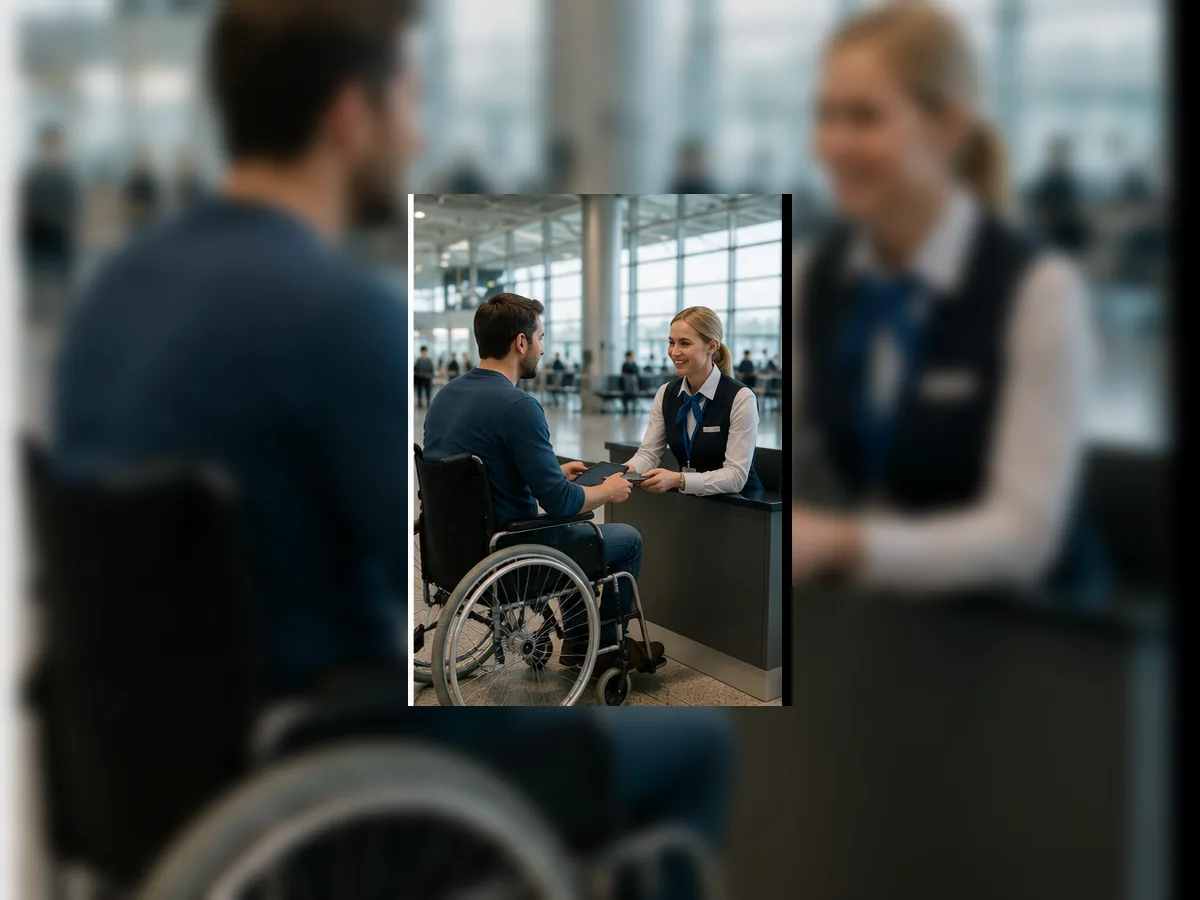
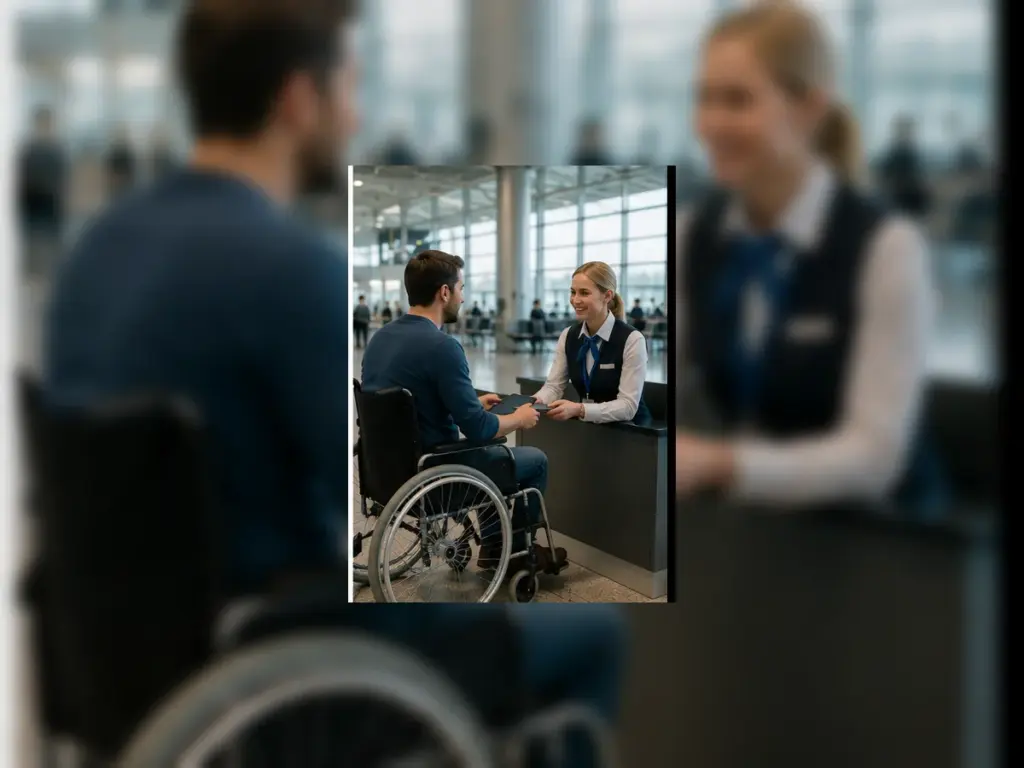
BER Airport accessibility is important for passengers with reduced mobility, wheelchair users, elderly travellers, families assisting a passenger, people with temporary injuries, hidden disabilities and anyone who needs a calmer or more supported airport process. Accessibility is not only about the terminal building. It also affects transport to the airport, check-in, security, passport control, baggage claim, meeting points and airport transfer timing.
This BER Airport accessibility guide explains what passengers should know before travelling through Terminal 1 or Terminal 2, how Mobility Service and wheelchair support can fit into the airport journey, and how to plan pickup or drop-off when extra assistance, luggage, walking time or reduced mobility matters.
Important: assistance availability, meeting points, opening hours and procedures can change by flight operation, terminal, airline and passenger need. Always request special assistance early and check current airline and airport instructions before travel.
BER Airport accessibility at a glance
- Airport: Berlin Brandenburg Airport Willy Brandt
- IATA code: BER
- Main terminals: Terminal 1 and Terminal 2
- Key support: Mobility Service, wheelchair loan, information points and passenger assistance
- Transport planning: terminal, walking distance, luggage, parking and transfer vehicle choice matter
- Transfer tip: tell the driver about reduced mobility, wheelchair use, luggage and assistance timing before pickup
What accessibility means at BER
Airport accessibility means that passengers can move through the travel process with appropriate support. This can include step-free routing, lifts, accessible toilets, wheelchair assistance, mobility support, information points, accessible parking, suitable meeting points and enough time for airport formalities.
Accessibility planning should cover the whole journey, not only the terminal. A passenger may need help from car to check-in, from check-in to security, from security to the gate, from aircraft to baggage claim, or from arrivals to the pickup point.
For broader passenger support, see BER Airport Services Guide and BER Airport Facilities Guide.
Mobility Service at BER
BER provides Mobility Service support for passengers with reduced mobility. This can include assistance with or without the passenger’s own wheelchair, depending on the booked need and the airport process.
Passengers should request assistance early, usually through the airline or travel provider, and should keep confirmation details accessible. The more specific the passenger is about walking distance, wheelchair use, stairs, transfer from seat, baggage and companion needs, the easier it is to plan correctly.
Wheelchair loan at BER
Wheelchair loan can be useful for passengers who need short-distance support inside the airport. Loan wheelchairs can help between terminal areas, check-in, security, gate, arrivals or service points, depending on availability and current airport rules.
A loan wheelchair is not the same as full assisted travel. If the passenger needs continuous support, help through formalities, boarding assistance or help from arrival to pickup, Mobility Service or airline-requested assistance may be more appropriate.
Terminal 1 accessibility
Terminal 1 is the main orientation point for many BER facilities and services. It connects check-in, departures, arrivals, public transport access, parking, service points and the train-station level.
For passengers with reduced mobility, Terminal 1 planning should include the exact entrance, check-in area, assistance meeting point, lift access, security process, gate walking distance and baggage plan. If a driver is dropping off a passenger, agree on the practical drop-off point and allow time for assistance.
For Terminal 1 orientation, see BER Airport Terminal 1 Guide.
Terminal 2 accessibility
Terminal 2 is within walking distance of Terminal 1. This connection can be manageable for many passengers, but it is important for anyone with reduced mobility, heavy luggage, children, elderly passengers or a tight departure.
If the flight uses Terminal 2, check whether the passenger needs a wheelchair, assistance, extra walking time or a different transfer plan. Terminal 2 passengers may also need to consider access to Terminal 1 facilities, the train station or pickup areas.
For Terminal 2 orientation, see BER Airport Terminal 2 Guide and BER Terminal 1 vs Terminal 2.
Accessible arrival at BER
Accessible arrival planning starts before the aircraft lands. Passengers may need assistance from the aircraft, support through border control, help reaching baggage claim, help with mobility aids or enough time to reach the public arrivals area.
If someone is meeting the passenger, they should not use landing time as exact meeting time. Assistance, baggage, passport control and walking to the pickup point can add time after the flight arrives.
For arrival timing, see BER Airport Arrivals Guide, BER Airport Baggage Claim Guide and Transfer from BER Airport.
Accessible departure from BER
Accessible departure planning should include transport to the terminal, unloading, assistance meeting point, check-in, baggage drop, security, passport control if required and boarding. Passengers who need assistance should arrive with a larger buffer than a hand-luggage-only passenger who can move quickly.
The airline’s check-in and boarding rules still matter. Assistance does not remove the need to arrive on time. It simply means the passenger journey should be planned with the right support and enough time.
For departure timing, see BER Airport Departures Guide, BER Airport Check-in Guide and Transfer to BER Airport.
Security control and accessibility
Security control can take longer for passengers with mobility aids, medical devices, medication, assistance needs or additional hand luggage. Passengers should prepare documents, medical items and electronics in a way that makes the process easier.
If the passenger uses a wheelchair or mobility aid, they should follow assistance staff and security instructions. Extra time is important, especially during busy periods or for international departures.
For security planning, see BER Airport Security Control.
Passport control and accessibility
Non-Schengen travel can require passport control. For passengers with reduced mobility, this can add time and may require coordination with assistance staff. EES and ETIAS-related processes can also affect non-EU travel planning.
Accessible travel should include border-control timing when relevant. Do not plan pickup or gate arrival only around the scheduled flight time.
For border planning, see Passport Control at BER Airport and EES and ETIAS at BER Airport.
Customs and accessible travel
Customs can matter for passengers arriving from outside the European Union, travelling with high-value goods, carrying medical equipment, bringing assistive devices or carrying items that require documentation.
If the passenger has reduced mobility and also needs customs support, allow extra time after baggage claim. Keep receipts, medical documentation and baggage details accessible until the arrival process is complete.
For customs planning, see BER Airport Customs Guide.
Baggage and mobility aids
Baggage planning is especially important for accessible travel. Passengers may travel with a wheelchair, walker, mobility scooter, medical equipment, extra bags, medication, oxygen-related documentation or special seating support.
Airline rules matter. Passengers should check how their mobility aid will be handled, whether it can be used to the gate, how batteries or medical devices are treated, and where it will be returned after arrival.
For baggage issues, see BER Airport Lost Luggage Guide.
Accessible parking and drop-off
Parking and drop-off should be planned around the passenger’s actual mobility. A short walking distance can still be too far for some passengers, especially with luggage or during bad weather.
If a passenger needs assistance from the vehicle, the driver should know this before arrival. For departures, allow time for unloading, finding assistance and reaching check-in. For arrivals, do not enter parking too early before the passenger is ready to meet.
For parking planning, see BER Airport Parking Guide.
Public transport and accessibility
The BER train station is below Terminal 1. Public transport can be useful, but passengers with reduced mobility should consider lifts, walking distance, luggage, platform access, service frequency and the connection between Terminal 1 and Terminal 2.
If public transport creates too much walking, waiting or uncertainty, a direct transfer may be easier. This is especially relevant for wheelchair users, elderly passengers, families, late-night arrivals or travellers with medical equipment.
For rail orientation, see BER Airport Train Station Guide.
Accessible airport pickup
Accessible pickup from BER should be planned around real exit time, not landing time. The passenger may need assistance from the aircraft, baggage help, border control, customs, a wheelchair return point or a slower route to the meeting area.
When booking pickup, provide the flight number, passenger phone number, terminal if known, luggage details, mobility needs and whether the passenger can walk to the car. If a wheelchair-accessible or larger vehicle is needed, mention this clearly before travel.
For airport pickup service, see Airport Transfers from BER Airport and Transfer from BER Airport.
Accessible airport drop-off
Accessible drop-off to BER should start with the airline’s check-in and assistance instructions. The pickup time should include road travel, unloading, assistance meeting, check-in, baggage drop, security and gate movement.
If the passenger needs help from the vehicle into the terminal, communicate this before the transfer. Not every vehicle or driver setup is suitable for every mobility need, so details matter.
Hidden disabilities and non-visible needs
Accessibility is not always visible. Some passengers need extra time, reduced stress, clearer instructions, assistance with navigation, help during security or a quieter process because of hidden disabilities, illness, anxiety, sensory needs or cognitive conditions.
Passengers should request assistance early and communicate practical needs clearly. A good plan can reduce stress and avoid last-minute confusion at check-in, security or boarding.
Families assisting passengers
Family members often help elderly passengers, children, disabled relatives or travellers with temporary injuries. This can make the airport process slower, especially with baggage, strollers, wheelchairs or medical equipment.
Plan who handles documents, who handles luggage, who speaks with assistance staff and who contacts the driver. Clear roles help avoid delays during check-in, security and arrival pickup.
Late-night accessible arrivals
Late-night arrivals can be more difficult for passengers needing accessibility support. The passenger may be tired, services may be more limited, and onward transport may be less convenient.
For late arrival, keep phone battery available, share the flight number and update the driver after assistance, baggage and border checks. Do not set an exact meeting time before the passenger is ready to exit.
For late-night planning, see Late-Night Arrival at BER Airport.
Accessible travel during delays and cancellations
Delays and cancellations are harder when assistance is needed. A passenger may need to wait longer, move to another gate, rebook, collect baggage, arrange a hotel or return from the airport.
If a flight changes, contact the airline and update assistance and transfer arrangements. Keep medical items, medication, chargers and important documents accessible during the disruption.
For disruption planning, see BER Airport Flight Delays Guide and BER Airport Flight Cancellations Guide.
Accessible hotels near BER
Airport hotels can help passengers with early departures, late arrivals or long waiting times. However, accessibility needs should be checked before booking: room access, lifts, bathroom setup, distance from terminal, transfer route and luggage handling.
If the passenger needs a step-free route or wheelchair-friendly room, confirm details directly before travel and allow extra time between hotel, terminal and flight process.
For hotel planning, see BER Airport Hotels Guide.
Opening hours and accessibility
Accessibility planning is also affected by opening hours and flight operations. Some services depend on time of day, terminal or flight schedule. Early departures and late arrivals need extra attention because fewer alternatives may be available.
Prepare essential items before arriving at BER: medication, documents, mobility-aid information, phone charger, snacks, water where allowed and contact details for airline, assistance and transfer.
For timing planning, see BER Airport Opening Hours Guide.
What to tell your airline
- Whether the passenger can walk short or long distances.
- Whether a wheelchair or mobility aid is used.
- Whether assistance is needed from check-in to boarding.
- Whether help is needed after arrival to baggage claim or exit.
- Whether medical equipment, batteries or special devices are carried.
- Whether the passenger needs extra time during security or boarding.
What to tell your transfer provider
- Full flight number.
- Terminal if known.
- Passenger phone number.
- Whether the passenger can walk to the vehicle.
- Wheelchair, walker or mobility-aid details.
- Number and size of suitcases.
- Whether assistance may delay pickup after landing.
- Destination address and any accessible entrance details.
Common accessibility mistakes at BER
- Requesting assistance too late.
- Using landing time as exact pickup time.
- Not checking whether the flight uses Terminal 1 or Terminal 2.
- Forgetting walking time between terminal areas.
- Not telling the driver about wheelchair or mobility needs.
- Choosing a vehicle without enough luggage or mobility-aid space.
- Not preparing medical equipment or battery information for airline checks.
- Ignoring extra time for security, passport control, baggage and customs.
BER accessibility checklist
- Request airline or Mobility Service assistance early.
- Confirm Terminal 1 or Terminal 2.
- Check where assistance begins at the airport.
- Allow extra time for check-in, security and boarding.
- Prepare documents for mobility aids or medical devices.
- Keep medication and essentials accessible.
- Tell the driver about reduced mobility and luggage needs.
- Use realistic pickup timing after arrival, not only landing time.
FAQ
Does BER Airport offer assistance for reduced mobility?
Yes. BER provides Mobility Service support for passengers with reduced mobility. Passengers should request assistance early and follow airline and airport instructions.
Can I borrow a wheelchair at BER?
Wheelchair loan is available at stations in Terminal 1 and Terminal 2 while stocks last. Passengers needing more complete support should arrange Mobility Service or airline assistance.
Is Terminal 2 close to Terminal 1?
Yes. Terminal 2 is within walking distance of Terminal 1, but passengers with reduced mobility should still allow extra time or request support if the walk is difficult.
Should pickup be based on landing time?
No. Accessible pickup should include assistance, deboarding, passport control if required, baggage claim, customs and movement to the meeting point.
What should I mention when booking a transfer?
Give the flight number, terminal, passenger phone number, luggage details, wheelchair or mobility-aid information and whether the passenger can walk to the vehicle.
Plan your accessible BER transfer
Accessible airport travel works best when assistance, terminal, luggage, timing and vehicle choice are planned together. For BER pickup or drop-off with reduced mobility, wheelchair needs, extra luggage or special passenger support, use online booking to arrange the route, vehicle and pickup details in advance.