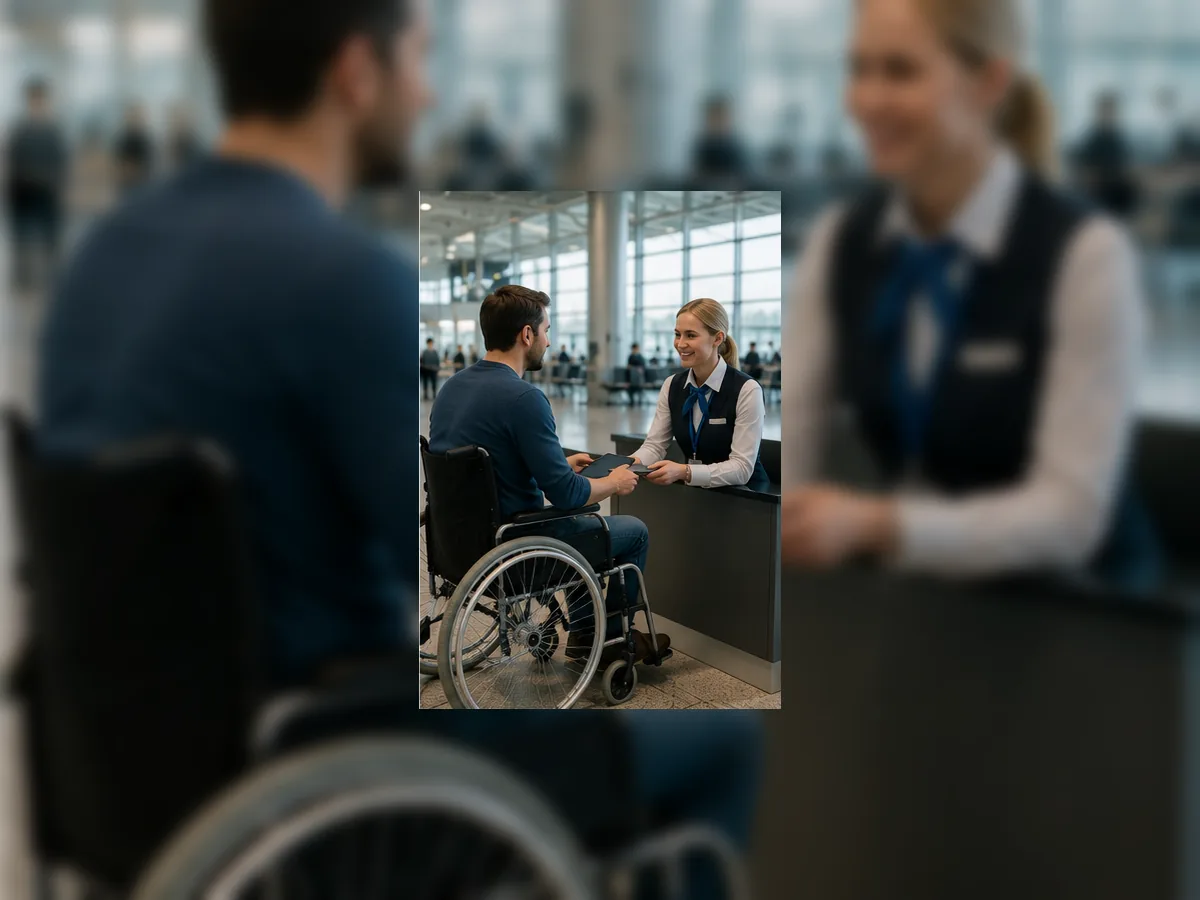
This BER Airport Disabled Travellers Guide explains how passengers with disabilities, reduced mobility, hidden disabilities, medical needs or additional support requirements can plan a smoother journey through Berlin Brandenburg Airport. The key is to prepare assistance, documents, terminal route, baggage, transport and timing before the travel day.
BER offers a Mobility Service for passengers with reduced mobility, support points in Terminals 1 and 2, wheelchair borrowing options, accessibility services and the Sunflower lanyard for hidden disabilities. This guide explains how those services fit into the full airport journey: arrival, departure, check-in, security, baggage claim, parking, taxi, train, public transport, hotel and private transfer.
Important: this guide is practical airport information, not medical advice. Service locations, opening hours, assistance rules, airline procedures, parking access and transport conditions can change. For urgent medical symptoms or emergency situations, contact airport staff or emergency services immediately.
BER disabled travellers guide at a glance
- Airport: Berlin Brandenburg Airport Willy Brandt
- IATA code: BER
- Main assistance service: Mobility Service for passengers with reduced mobility
- Booking advice: inform the airline or travel organiser no later than 48 hours before departure when possible
- Hidden disabilities: Sunflower lanyard is available without proof at passenger information desks and Mobility Service
- Wheelchair borrowing: wheelchairs can be borrowed free of charge at 21 stations in Terminals 1 and 2 while stocks last
- Best rule: plan assistance, terminal route and transport as one journey, not as separate steps
Who should use this guide?
This guide is for travellers with reduced mobility, wheelchair users, passengers with hidden disabilities, senior travellers, people recovering from illness or injury, passengers with medical devices, families assisting a disabled traveller, and anyone who needs extra time or support at BER.
The guide also helps travel organisers, assistants, hotels, drivers and family members understand how airport assistance, terminal route and transfer timing should work together.
For the broader accessibility overview, see BER Airport Accessibility Guide.
Mobility Service at BER
The Mobility Service supports passengers with reduced mobility at BER. It can help passengers with or without their own wheelchair and is intended to support the airport journey from check-in to boarding, depending on the passenger’s needs and the travel stage.
Travellers should inform their airline or travel organiser about assistance needs during booking, and no later than 48 hours before departure where possible. This gives the airport and airline time to plan support.
For health-related travel context, see BER Airport Medical Services.
Where are Mobility Service points at BER?
BER lists Mobility Service points in Terminals 1 and 2. Important reference points include Terminal 1 Level E1 in the check-in hall, Terminal 1 Level E1 in the Market Place security area, and Terminal 2 Level E0 in the check-in area.
Passengers should check the correct terminal before travelling. A passenger departing from Terminal 2 should not assume the same route as a Terminal 1 passenger.
For terminal orientation, see BER Airport Terminal 1 Guide, BER Airport Terminal 2 Guide and BER Terminal 1 vs Terminal 2.
Mobility Service before departure
Before departure, the Mobility Service plan should start before the passenger reaches the terminal. Confirm assistance with the airline, check terminal, prepare documents, allow extra time, and decide how the passenger will arrive at the airport.
On the day of departure, the passenger should report to the relevant service point or assistance location according to the plan. Do not wait until security or boarding to ask for help if assistance was needed from check-in.
For departure planning, see BER Airport Departures Guide and BER Airport Check-in Guide.
Mobility Service after arrival
After arrival, passengers with reduced mobility may need support from aircraft to baggage claim, public arrivals, taxi, pickup point, parking, train station or another transfer route. The exact route depends on airline, terminal and assistance plan.
If a driver, family member or hotel transfer is waiting, they should understand that assisted arrival may take longer than scheduled landing time.
For arrival planning, see BER Airport Arrivals Guide, BER Airport Baggage Claim Guide and BER Airport Customs Guide.
Sunflower lanyard for hidden disabilities
The Sunflower lanyard is a discreet signal for people with hidden disabilities. It helps airport staff and other people understand that the passenger may need more time, patience or support, even if the disability is not visible.
At BER, the Sunflower lanyard is available without proof at passenger information desks and from the Mobility Service. It can also be helpful for family members or travel companions supporting a person with a hidden disability.
Hidden disabilities at the airport
Hidden disabilities can include conditions that are not immediately visible but make airport movement, crowds, noise, queues, security checks or time pressure more difficult. The Sunflower lanyard does not explain the passenger’s condition, but it can make support needs easier to signal.
Passengers with hidden disabilities should still plan their route, documents, assistance, medication and transport in advance. The lanyard is a support tool, not a replacement for booked assistance where direct help is needed.
Wheelchair borrowing at BER
BER offers free wheelchair borrowing at 21 stations in Terminals 1 and 2 while stocks last. Passengers can use a loaner wheelchair through security and return it at another station.
This can help passengers who do not use a wheelchair permanently but need support for long airport distances. If a passenger needs full assistance from check-in to boarding, Mobility Service should still be arranged.
Own wheelchair vs loaner wheelchair
Travellers who bring their own wheelchair should check airline rules before travel, including battery rules for electric wheelchairs, size, handling and boarding procedures. Travellers using a loaner wheelchair should not assume availability at all times.
If wheelchair support is essential, arrange Mobility Service in advance rather than relying only on a loaner being available on arrival.
Check-in with reduced mobility
Check-in can take longer for disabled travellers because of baggage, mobility devices, medical equipment, assistance coordination and airline procedures. Arrive with enough time and keep documents accessible.
Passengers with mobility devices or medical equipment should check airline rules before the travel day. The airport process is easier when airline, assistance and transport are already aligned.
Security control with disabilities
Security control can be stressful for disabled travellers, wheelchair users, passengers with medical devices and people with hidden disabilities. Extra time and clear communication help.
Prepare medicines, liquids, electronic devices, mobility aids and medical documents before reaching the screening point. Follow security staff instructions and ask for help if the process is unclear.
For screening planning, see BER Airport Security Control and BER Airport Fast Track Guide.
Passport control and border checks
Non-Schengen flights may require passport control. Disabled travellers should include this extra step in their timing, especially if queues, walking distance or assistance coordination are relevant.
Keep passport, residence documents, visas, medical documents and assistance information accessible, not buried in checked luggage or a hard-to-reach bag.
For border planning, see Passport Control at BER Airport and EES and ETIAS at BER Airport.
Baggage claim with reduced mobility
Baggage claim can be difficult when a passenger uses a wheelchair, walking aid or medical device. It can also take longer if assistance is needed to reach the carousel or move luggage.
Drivers and family members should not plan pickup from scheduled landing time. The realistic pickup time is after assistance, baggage claim and customs are complete.
For baggage planning, see BER Airport Lost Luggage Guide and BER Airport Transport with Luggage.
Medical equipment and medicine
Disabled travellers may travel with medicine, medical devices, mobility equipment, batteries, liquids, syringes or documents. These items should be planned with the airline before travel.
Essential medicine should stay in hand luggage whenever allowed. Do not place critical medicine only in checked baggage.
For pharmacy and health planning, see BER Airport Pharmacy and BER Airport Medical Services.
Terminal 1 accessibility planning
Terminal 1 is the main reference point for check-in, security, Market Place, airport services, taxi ranks, the airport train station and Airport City hotels. Many disabled travellers will use Terminal 1 at some point in the journey, even if transport or hotels are part of the plan.
Plan the route in stages: arrival at the terminal, check-in, assistance point, security, gate, boarding, or on arrival from aircraft to baggage claim and transport.
Terminal 2 accessibility planning
Terminal 2 has a smaller service footprint than Terminal 1 but has its own check-in and service references. Disabled travellers using Terminal 2 should check the exact terminal route and assistance point before travelling.
Do not assume that a Terminal 1 plan automatically works for Terminal 2. Walking time, lifts, pickup location and assistance point can differ.
Accessible parking at BER
BER parking information indicates that parking spaces for passengers with reduced mobility are available on every level in all car parks, though they cannot be specifically booked online. Travellers should display proof of entitlement visibly behind the windscreen where required.
Accessible parking should be planned together with terminal route, luggage, wheelchair needs and passenger pickup timing.
For parking planning, see BER Airport Parking Guide, BER Airport Pick-up Areas, BER Airport Drop-off Areas and BER Airport Kiss & Fly Guide.
Taxi for disabled travellers
Taxi can be useful when a disabled traveller needs direct transport after arrival. The official taxi ranks are in front of Terminal 1 on Level E0.
Travellers who need a wheelchair-accessible taxi or extra luggage space should not assume every vehicle will be suitable. If vehicle fit matters, pre-arranged transport is often safer.
For taxi planning, see BER Airport Taxi Rank Guide.
app-based ride services for disabled travellers
app-based ride services can work for some travellers, but they depend on phone battery, mobile data, vehicle availability, pickup point, walking distance and vehicle suitability.
If a passenger has a wheelchair, walking aid, medical equipment or hidden disability, a ride app may not be predictable enough unless the vehicle and pickup location are suitable.
For ride app planning, see BER Airport Taxi Rank Guide.
Private transfer for disabled travellers
A private transfer can be helpful when the passenger needs a planned route, enough luggage space, driver contact, hotel address, flexible timing after assistance, or a calmer journey to Berlin.
When booking, clearly state wheelchair, walking aid, luggage, extra time, mobility limits and pickup requirements. Do not wait until arrival to explain important needs.
For planned airport transport, see Airport Transfers from BER Airport, Transfer from BER Airport and Transfer to BER Airport.
Train travel with reduced mobility
The airport train station is under Terminal 1 on level U2. Train can be suitable when the route is accessible, direct and realistic for the passenger’s condition.
Before choosing train, check lifts, platform route, luggage, final station, hotel distance and whether assistance is needed beyond the airport.
For rail planning, see BER Airport Train Guide and BER Airport Train Station Guide.
Public transport for disabled travellers
Public transport can work for disabled travellers, but it requires a realistic route. Airport Express, regional trains, S-Bahn and buses can be affected by lift access, platform changes, luggage, crowds and late-night timing.
If the journey includes several changes or a long final walk, taxi or private transfer may be easier.
For public transport planning, see BER Airport Public Transport Guide, BER Airport Bus Guide, FEX Airport Express at BER Airport, BER Airport Regional Trains and BER Airport S-Bahn Guide.
Bus stop B and assistance
Some shuttle, tour and intercity buses use Bus stop B. BER notes that passengers with reduced mobility can request assistance via a dedicated call point on site there.
Bus stop B is not the same as the taxi rank, ride app pickup or train station. Disabled travellers should confirm the route and distance before walking there with luggage.
Airport hotels and disabled travellers
Airport hotels can make the journey easier for disabled travellers before early flights or after late arrivals. Staying close to Terminal 1 can reduce road travel, night transport stress and early morning timing pressure.
Travellers should confirm accessible room needs, lift access, bathroom requirements and transfer route before booking.
For hotel planning, see BER Airport Hotels Guide, BER Airport Hotels for Early Flights, BER Airport Hotels for Late Arrivals and BER Airport Business Hotels.
Disabled travellers before early flights
Before an early flight, assistance, transport, medicine, documents, phone battery and luggage should be prepared the night before. Early morning is not the right time to solve wheelchair, pharmacy, taxi or check-in problems.
For many disabled travellers, an airport hotel or pre-booked transfer can reduce stress before an early departure.
For early travel planning, see BER Airport Early Morning Transport.
Disabled travellers after late arrivals
After a late arrival, disabled travellers may face reduced public transport frequency, tiredness, medication timing, limited service hours and longer transfer waiting time. A clear plan is important.
If the passenger needs assistance from aircraft to public arrivals, the driver or family member should wait for confirmation rather than timing pickup from landing time.
For late-arrival planning, see Late-Night Arrival at BER Airport and BER Airport Night Transport.
Disabled travellers during flight delays
Flight delays can affect medicine timing, fatigue, mobility support, food, water, charging and transport. Passengers who need assistance should keep airline and airport updates visible and ask for support before the situation becomes urgent.
If a transfer is booked, update the pickup plan when the delay becomes clear.
For delay planning, see BER Airport Flight Delays Guide and BER Airport Flight Status Guide.
Disabled travellers during cancellations
A cancelled flight can create hotel, rebooking, baggage and transport problems. Disabled travellers may need assistance, medicine, accessible hotel rooms, suitable transfer and extra time.
Handle health and mobility needs first, then rebooking and transport. Do not accept a plan that creates an impossible terminal or city route.
For cancellation planning, see BER Airport Flight Cancellations Guide.
Family and companion support
Travel companions should know the passenger’s assistance plan, documents, medicine, luggage, pickup point and emergency contact. A companion can help with communication, but the airport or airline should still be informed when official assistance is needed.
For families travelling with children and a disabled traveller, allow even more time for toilets, food, baby changing and transport.
For family planning, see BER Airport Family Services Guide, BER Airport Family Areas and BER Airport Baby Changing Rooms.
Food, water and medication timing
Some disabled travellers need regular food, water or medication timing. Plan food stops around check-in, security, boarding and transport. Terminal 1 has the strongest food and service selection.
Do not delay medication because the family or group is rushing to the gate or transport.
For food planning, see BER Airport Food Guide, BER Airport Restaurants Guide and BER Airport Cafes Guide.
Wi-Fi, SIM cards and communication
Disabled travellers may need phone contact with airline, assistance staff, hotel, driver, family, doctor or travel organiser. Airport Wi-Fi helps inside the terminal, while eSIM or roaming is important after leaving BER.
Save important documents and contact details offline in case mobile data is weak.
For connectivity planning, see BER Airport Wi-Fi Guide and BER Airport SIM Cards.
Charging devices for assistance and transport
A charged phone is essential for assistance updates, transfer messages, hotel contact, payment, route changes and emergency calls. Bring a powerbank and cable if the journey is long.
Do not leave the terminal with a nearly dead phone if your transfer, hotel or medical communication depends on it.
For charging planning, see BER Airport Charging Stations.
Payment and receipts
Disabled travellers may need receipts for taxi, transfer, pharmacy, hotel, parking or medical-related purchases. Business travellers and insurance cases should keep receipts from the start.
Carry more than one payment method if possible, especially after late arrivals or during disruptions.
For money planning, see BER Airport ATMs Guide and BER Airport Currency Exchange Guide.
Disabled travellers checklist for BER
- Inform airline or travel organiser about assistance needs no later than 48 hours before departure where possible.
- Confirm Terminal 1 or Terminal 2 before travel.
- Prepare medicine, documents, mobility device information and baggage rules.
- Use Mobility Service points or call boxes when assistance is needed.
- Use the Sunflower lanyard if hidden disability support is helpful.
- Do not rely only on loaner wheelchairs if assistance is essential.
- Plan transport from the airport before arrival.
- Use online booking if a fixed transfer is safer than last-minute taxi or ride app planning.
Common mistakes to avoid
- Not requesting Mobility Service in advance.
- Assuming Terminal 1 and Terminal 2 have identical routes.
- Timing pickup from landing time instead of assisted exit time.
- Leaving essential medicine in checked luggage.
- Assuming every taxi or ride app vehicle fits a wheelchair or mobility aid.
- Leaving phone charging until the last minute.
- Ignoring parking route and terminal distance.
- Treating the Sunflower lanyard as a replacement for booked assistance.
FAQ
Does BER Airport have assistance for disabled travellers?
Yes. BER offers Mobility Service for passengers with reduced mobility. Travellers should inform their airline or travel organiser about assistance needs in advance, ideally no later than 48 hours before departure.
Where is Mobility Service at BER?
Mobility Service points are available in Terminals 1 and 2, including Terminal 1 Level E1 check-in hall, Terminal 1 Level E1 Market Place and Terminal 2 Level E0 check-in area.
Can I borrow a wheelchair at BER?
Yes. Wheelchairs can be borrowed free of charge at 21 stations in Terminals 1 and 2 while stocks last. If full assistance is needed, arrange Mobility Service in advance.
Does BER support hidden disabilities?
Yes. BER offers the Sunflower lanyard for hidden disabilities. It is available without proof at passenger information desks and from the Mobility Service.
Is taxi or private transfer better for disabled travellers at BER?
It depends on the passenger’s needs. Taxi can work for simple journeys, but private transfer is often more predictable when wheelchair space, luggage, extra time or specific pickup details matter.
Plan assistance and transfer together
Disabled travel at BER works best when Mobility Service, terminal route, medicine, baggage, parking and transport are planned together. For travellers who prefer fixed pickup details, luggage space and door-to-door travel after arrival or before departure, use online booking to arrange a BER airport transfer in advance.